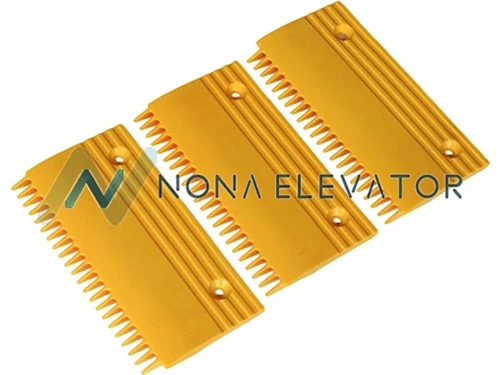
If you're an escalator tech, facility manager, or part handler, you know the comb plate on a KONE escalator is way more than a random metal strip at the top/bottom landing. It's that safety feature that stops shoes, bags, or loose items from getting caught between the step and the fixed structure. Mess up its position, and you're looking at jams, loud squeaks, even minor injuries-plus the kind of downtime that makes your clients (or your boss) groan. As a KONE escalator comb plate supplier, I've fixed my fair share of misaligned comb plates over the years, and today I'm breaking down how to adjust it right, no guesswork required.
First, let's do a quick recap so we're all on the same page. The comb plate has little teeth that slot perfectly into the notches on the escalator steps. If those teeth don't line up? The gap widens, and foreign objects get wedged in. Worse, if the plate's too tight, it can scrape steps and wear them out faster. Before you even grab tools, though, you've gotta prep right. Skipping pre-checks is how techs cut corners and end up having to redo the adjustment twice.
Start with a basic safety lockout/tagout (LOTO) routine. I see so many folks skip this, but it's non-negotiable-escalators move, even when they're "off." Shut off the main power, slap a lock on the disconnect, and post a sign so no one can flip it while you're working. Next, inspect the current state of the comb plate. Pop off the trim cover around the landing (it usually just pries off with a flat screwdriver, no screws) to get to the comb plate mounting bolts. Count how many teeth are misaligned-half or more off? That means the plate's not just slightly shifted, you might need to check the whole mounting assembly, not just loosen bolts.


Now, let's talk tools: you'll need a 10mm or 12mm socket (depends on your KONE model-most newer ones use 10mm), a Phillips screwdriver, a level (small torpedo level works perfect here), and maybe a rubber mallet for small tweaks. Pro tip: grab a notepad to mark your starting position, so you know exactly how far to move the plate-no winging it, that's how you over-adjust.
Here's the step-by-step adjustment process, broken down for KONE specifically. First, loosen the two or four mounting bolts that hold the comb plate to the landing frame-don't fully remove them, just break them loose, so the plate can slide a little. Now, line up the comb teeth with the step notches. How? Take a step that's stopped at the landing, and check the gap between the comb tooth and the step notch. The gap should be no bigger than 2mm, per KONE's specs. If you're on a KONE Modular escalator, the comb plate has guide pins that fit into slots-use those pins to get a rough line, then double-check with a step.
Wait, another thing: the comb plate's top surface needs to be level with the top of the steps. If it's too high, it'll trip people; too low, it can catch the step edge. That's where the torpedo level comes in. Rest it on the comb plate, and adjust the shims (small metal or plastic spacers under the comb plate) if needed. If it's too low, add a thin shim under the bolt head; too high, remove a shim. Don't over-shim-more than two shims can cause the plate to wobble later.
Once you've got the teeth lined up and the plate level, tighten the mounting bolts in a crisscross pattern. Don't just tighten one side all the way- that'll pull the plate off-kilter. Torque them to 15 Nm for most KONE models (check your service manual, but that's the go-to I've used for 10+ years). After tightening, test it: run a step through the comb plate by hand (slow mode, if you have it) to make sure there's no scraping or catching. If it still squeaks or lags, loosen the bolts, nudge the plate 1-2mm, and try again.
Wait, what if even after adjusting, the comb plate still won't line up? It might not be the plate's fault-could be worn parts nearby. Like, if the steps are off track, or the guide rollers are shot. For example, if your KONE steps are skipping, you might need to replace a step roller-we carry KONE escalator friction wheels, which are compatible with most mid-size KONE escalators, but always double-check the model number before ordering. Another part to keep in mind: if this is a travelator, not a regular escalator, the pallet might be off, which could throw off your comb plate alignment. In that case, parts like OTIS travelator pallet XAA26340F3 are made for travelators, so make sure you're grabbing the right part for the job.
I've also seen techs mistake misaligned comb plates for bad guide rollers. If you're working on an OTIS escalator, for example, a worn XIZI OTIS escalator guide roller 120x30x6203 can make the steps shift, which pulls the comb plate out of line. Before you adjust the comb, spin a few guide rollers to see if they're wobbly-if they are, that's your real issue, not the comb plate. Same with step rollers: a faulty OTIS escalator step roller 76x22x6203 will make steps lean, so even a perfectly adjusted comb plate will look off.
Now, common mistakes to avoid, because I've been there. First, ignoring the power lockout-last year, a new tech on our team forgot to lock out the disconnect, and the escalator accidentally turned on; he narrowly missed getting his hand pinched. Don't be that guy. Second, over-tightening the bolts-this warps the comb plate, so even if it looks aligned, the teeth will bend and break over time. Third, skipping the test run after adjustment-you'd be surprised how many times a comb looks right on the bench, but when the step moves, it's catching.
Another pro tip: if you're working on a Mitsubishi escalator, the comb plate adjustment is a little different, but the core rule (teeth to step notches, level plate) still applies. We have Mitsubishi escalator step wheels in stock too, if you need to fix step alignment there, but today we're focused on KONE.
When you're done adjusting, do a final check: run the escalator in both up and down directions, watch the comb teeth for any gaps bigger than 2mm, listen for any grinding, and make sure no debris is caught between the teeth. If it passes, clean the trim cover, put it back on, and double-sign your work order-nothing looks worse than a "fixed" escalator that's still making noise on the first test.
Now, if you're in a pinch and need a replacement comb plate, or any of the parts I mentioned (guide rollers, friction wheels, step rollers, pallets), we stock genuine KONE and compatible parts for all major brands. We ship fast, and our team has 15+ years of escalator part experience, so if you're not sure which part you need, just hit us up-we'll help you pick the right one. Don't waste time with cheap, generic parts that break in a month; go with reliable, compatible parts from a supplier you can trust.
Wait, one last thing: a lot of people ask if they should adjust the comb plate without a service manual. The short answer: no, if it's a newer KONE model, there are tiny adjustment screws on the back of the comb plate that only the service manual will tell you about. For older KONE models, the mounting bolts are usually your only adjustment point, but even then, it's good to cross-check with a service manual to avoid messing up the safety gap.
If you're a facility manager reading this, make sure your techs have a checklist for comb plate adjustments. It's a small part, but it's a huge safety item. And if you're running low on comb plates or any related parts, we've got you covered-just reach out for a quote, no hassle, no hidden fees.
References:
- KONE Escalator Service Manual (Modular Model, 2022 Edition)
- ASME A17.1 Safety Standard for Elevators and Escalators, Section 10.12
- Escalator Parts Industry Best Practices 2023, International Association of Elevator Contractors